- April 28, 2026
- TheHighlineDispensary
- No Comments
The Science of Getting High: How THC Affects the Brain
Getting high isn't magic — it's specific molecules binding to specific receptors in specific brain regions. Understanding the biology makes every subsequent cannabis decision sharper.
Every time you feel cannabis hit, a specific chain of events is happening in your brain. THC molecules cross the blood-brain barrier, find their way to specialized receptors, and alter the signaling between neurons. The feelings you experience — euphoria, relaxation, altered perception, the munchies, time dilation — are all downstream effects of this process.
Understanding the science doesn't reduce the experience; it enriches it. And it makes you dramatically better at making cannabis choices that actually serve you.
Step One: THC Enters the Bloodstream
Everything starts with getting THC into circulation. The three main routes:
- Inhalation (smoking, vaping) — THC passes from lung tissue into the bloodstream within seconds. Peak blood concentration within 3-10 minutes. Fastest onset of any method.
- Sublingual (tinctures) — Absorption through mucous membranes in the mouth. Onset within 15-30 minutes.
- Oral (edibles) — THC goes through the digestive tract, gets absorbed in the small intestine, and passes through the liver before entering general circulation. Onset 30-120 minutes. Longer-lasting but slower-building.
See our consumption methods guide for a full breakdown of the practical differences.
Step Two: Crossing Into the Brain
Once THC is in the bloodstream, it needs to reach the brain. Fortunately (for the purposes of getting high), THC is highly lipophilic — fat-soluble — which means it crosses the blood-brain barrier easily. Within minutes of entering circulation, it's in the brain tissue.
From there, THC can diffuse to any brain region where CB1 receptors are present. And they're everywhere.
Step Three: Binding to CB1 Receptors
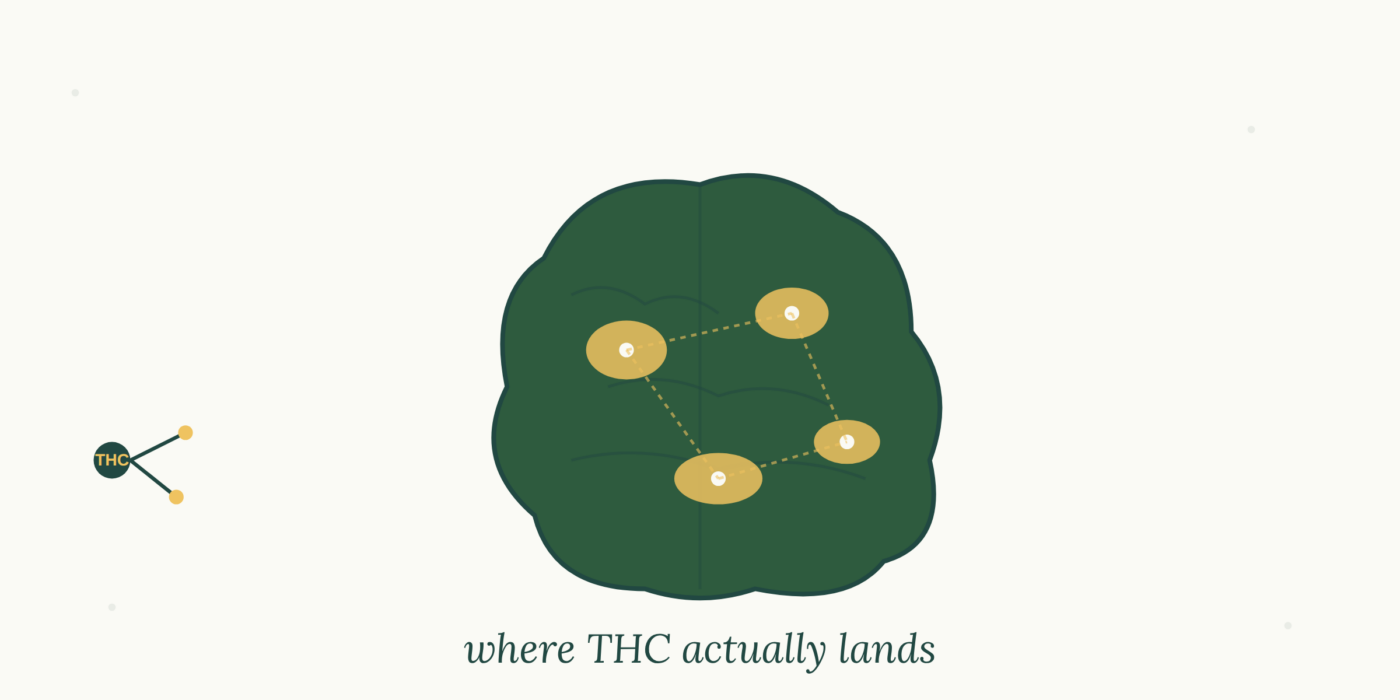
CB1 receptors are proteins that sit on the surface of certain neurons. When activated by a cannabinoid (your body's own or one from cannabis), they change the behavior of the cell. Specifically, they suppress the release of neurotransmitters from that neuron.
This is the key mechanism: THC doesn't directly excite or inhibit your brain. It dampens the normal back-and-forth signaling between neurons. What you experience as "high" is actually your brain operating with reduced inter-neuronal chatter.
CB1 density varies enormously by brain region. The regions with the highest CB1 concentrations are the ones most affected by cannabis:
| Brain Region | Normal Function | Cannabis Effect |
|---|---|---|
| Hippocampus | Short-term memory formation | Difficulty forming new memories during use |
| Cerebellum | Motor coordination, balance | Altered coordination, slower reaction time |
| Basal ganglia | Movement and reward | Slowed movement, heightened sense of reward |
| Prefrontal cortex | Decision-making, time perception | Altered judgment, time dilation |
| Amygdala | Fear, anxiety, emotion | Emotional shifts (either direction) |
| Hypothalamus | Appetite, hormones, temperature | The munchies, altered body temperature |
| Brainstem (sparse) | Breathing, heart rate | Minimal direct effect — why THC overdose isn't fatal |
The Phases of a THC High
Onset (Minutes 1-15, Inhaled)
THC floods CB1 receptors. Peripheral effects kick in first — dry mouth, red eyes, slight head pressure. Central effects begin: mild euphoria, altered sensory perception, a sense of relaxation or alertness depending on strain. This is the "coming on" phase.
Peak (Minutes 15-45, Inhaled)
Maximum CB1 activation. Full sensory and cognitive effects. Time perception alters. Memory formation becomes harder. Mood shifts. Appetite often increases. Depending on dose and individual, this is either "right in the pocket" or "too much."
Plateau (Minutes 45-120, Inhaled)
Effects remain but the sharp peak fades. Still clearly under the influence but the rollercoaster phase is over. Your brain is doing its thing to compensate and restore balance.
Coming Down (Hours 2-4+, Inhaled)
CB1 occupancy drops. Perception and cognition return to baseline. Some people feel tired, hungry, or mellow. Memory for the session may be patchy, especially the peak.
Edibles stretch this whole sequence out — onset at 30-120 minutes, peak at 2-4 hours, plateau for 2-4 more hours, total duration up to 8 hours. The compound your liver produces from oral THC (11-hydroxy-THC) is more potent and longer-lasting than the THC from inhalation.
Why Cannabis Affects People Differently
Two people can consume the same product and have wildly different experiences. This is not random. Several factors drive it:
Individual CB1 Density
People naturally have different baseline CB1 receptor concentrations. More receptors, more dramatic effect at a given dose.
Endocannabinoid System State
If your baseline endocannabinoid levels are high (good exercise, good sleep, good nutrition), adding THC produces different effects than if you're depleted (chronic stress, poor sleep, sedentary). See our ECS guide for the full picture.
Enzyme Activity
Liver enzymes (particularly CYP2C9 and CYP3A4) metabolize THC at rates that vary genetically. Fast metabolizers clear THC quickly; slow metabolizers feel more intense and longer-lasting effects.
Previous Experience
Tolerance — downregulated CB1 receptors from regular use — means the same dose produces less effect. See our tolerance and T-breaks guide.
Set and Setting
Mood, environment, and expectations all meaningfully shape the experience. Anxious people in unfamiliar environments are more likely to have difficult experiences; relaxed people in comfortable settings are more likely to have pleasant ones. This isn't placebo — it's real psychology interacting with real neuroscience.
The Entourage Effect and Why Strains Feel Different
If the high were just "CB1 receptor activation by THC," every cannabis product with the same THC content would feel identical. It obviously doesn't.
Other cannabinoids (CBD, CBG, CBN) and terpenes also influence the receptor system and broader neurochemistry. This is the "entourage effect" — the theory that cannabis compounds work better and differently together than any single one alone (Russo, 2011).
This is why:
- High-myrcene strains often feel more sedating (myrcene may enhance THC's sedating properties)
- High-CBD products feel gentler (CBD moderates some CB1 effects)
- High-pinene strains may feel more alert (pinene may counteract some memory effects)
- Two flowers with identical THC percentages can feel completely different
See our terpenes guide for more on how aromatic compounds shape the experience.
What Cannabis Doesn't Do to the Brain
Some myths about cannabis and the brain are persistent. Worth clearing up:
- It doesn't kill brain cells the way decades of popular culture claimed. That specific claim traces back to flawed studies.
- It doesn't cause permanent IQ loss in adults. Research on adult use shows effects that reverse with abstinence.
- It doesn't cause overdose death. The brainstem (which controls breathing and heart rate) has very few CB1 receptors, which is why there's no known lethal dose. However, severe panic, paranoia, and motor impairment from overconsumption are very real.
That said, some effects are concerning and well-supported:
- Adolescent use (under 18, especially under 16) appears to have more lasting effects on brain development. This is one reason NY law restricts cannabis to 21+.
- In people predisposed to psychosis, heavy cannabis use can precipitate earlier onset. The relationship is complex and not fully causal, but it's a real signal.
- Heavy chronic use affects cognitive function temporarily and can affect learning in demanding situations.
What All of This Means Practically
Takeaways for shopping smarter
- High THC percentage is one variable among many — terpenes and minor cannabinoids meaningfully shape the experience
- Different consumption methods engage the same receptors but at different speeds and durations
- Tolerance is CB1 receptor downregulation — biological, predictable, reversible
- Individual response varies because ECS biology varies
- Set and setting are real contributors to your experience
One Last Thought
Cannabis doesn't break the brain's normal operation — it temporarily modifies it. The brain compensates during use and returns to baseline after. That's why it's possible to use cannabis responsibly across decades. The people who do so best are usually the ones who understand what's happening and respect it.
What to look for at The Highline
A snapshot of the kinds of products our team can walk you through. Tap any category for what's in stock right now.
Local? We deliver to Dobbs Ferry, Ardsley, Irvington, and Yonkers. Or come visit us at 45 Main Street, Hastings-on-Hudson. Browse our live menu for what's in stock today.
Common Questions
Why does cannabis affect memory?
CB1 receptors are heavily concentrated in the hippocampus — the brain's memory center. When THC binds to these receptors, it disrupts the normal formation of short-term memories. This is why it can be hard to remember exactly what happened during a session; the brain wasn't forming memories normally at the time.
Does cannabis cause long-term brain damage?
Research on adult cannabis use shows generally temporary effects that reverse with abstinence. Heavy adolescent use (particularly under age 16) is associated with more concerning, potentially lasting effects on brain development. Adult brains are more resilient. This is a major reason NY law restricts cannabis to ages 21+.
Why do I feel different parts of the high separately?
Different brain regions have different densities of CB1 receptors and different functions. THC binding in the cerebellum affects coordination; in the hippocampus affects memory; in the basal ganglia affects movement and reward. The combined effect is what you experience as 'high.'
Why does cannabis affect time perception?
Brain regions involved in time perception, including the prefrontal cortex and cerebellum, have significant CB1 receptor presence. THC disrupts the normal neural signaling these regions use to track time, which is why seconds can feel like minutes under the influence.
Why do different strains create different highs?
Individual cannabinoid profiles, terpene content, and your own endocannabinoid system all influence which brain regions are most affected. High-myrcene strains may affect body regions more; high-pinene strains may preserve alertness. The experience isn't just 'THC on'; it's a complex chemical symphony.
Keep Reading
Ready when you are.
Three ways to start — whichever fits your day.
Or join the VIP list for new drops and member-only deals →