- April 28, 2026
- TheHighlineDispensary
- No Comments
Cannabis Tolerance & T-Breaks: What You Need to Know
If your usual cannabis feels weaker than it used to, you're not imagining it — tolerance is real, predictable, and reversible. Here's how it works and what to do about it.
If you've been using cannabis regularly for a while and things just don't hit the way they used to, you're experiencing tolerance. It's one of the most well-documented aspects of cannabis use, it has a clear biological explanation, and — best news — it's completely reversible.
Understanding tolerance is understanding your own endocannabinoid system. Let's break it down.
What Tolerance Actually Is
Tolerance is what happens when your body adapts to a substance. With cannabis, the adaptation happens primarily at the CB1 receptors in your brain and body (see our endocannabinoid system guide for more on how these work).
When you consume THC regularly, your CB1 receptors do two things to protect themselves from constant stimulation:
- Downregulation — the cells actually reduce the number of CB1 receptors on their surface. Fewer receptors means less THC can bind, means less effect per dose.
- Desensitization — the receptors that remain become less responsive. Same number of receptors, weaker signal.
This adaptation is a normal, protective biological response. It happens with many substances (alcohol, caffeine, opioids) through various mechanisms. Your body is trying to maintain balance.
The Research on Cannabis Tolerance
A widely-cited 2012 study using PET brain imaging showed that chronic daily cannabis users had about 20% fewer CB1 receptors than non-users, particularly in brain regions relevant to mood and cognition. The encouraging finding was what happened with abstinence — after just four weeks without cannabis, receptor density had substantially normalized (Hirvonen et al., 2012).
The practical translation: tolerance builds in weeks, reverses in weeks. It's not permanent.
How Quickly Does Tolerance Build?
| Use Pattern | Tolerance Development |
|---|---|
| Occasional (1-2x/week) | Minimal tolerance; reset happens between sessions |
| Regular (3-5x/week) | Gradual build over weeks; modest tolerance |
| Daily | Noticeable tolerance in 1-2 weeks |
| Multiple times daily | Significant tolerance in 2-4 weeks |
| Chronic heavy use (6+ months) | Profound tolerance; some reset takes longer |
Signs You've Built Tolerance
Common indicators
- Your usual dose doesn't produce the effects it used to
- You're using more per session to get the same feeling
- You're using more frequently than you used to
- Premium products feel "mid" — nothing impresses the way it once did
- You've stopped getting anxious or overwhelmed from too much (which was your natural dose limiter)
- The pleasant effects are muted; side effects (dry mouth, grogginess) are still present
The T-Break: Tolerance Breaks Explained
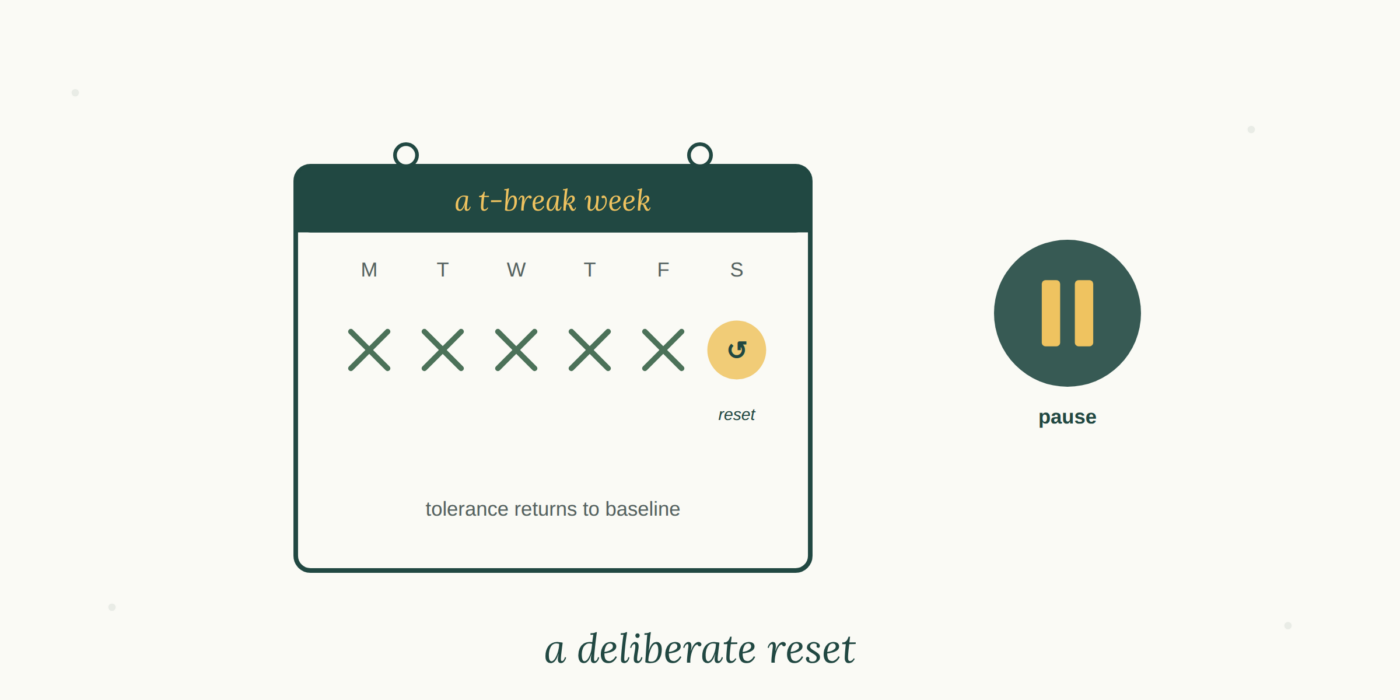
A tolerance break — "T-break" — is a period of abstinence from THC-containing cannabis, long enough to reset CB1 receptor density and sensitivity.
How Long Is Enough?
The research-supported answer:
- 48 hours — CB1 receptors start recovering
- 1 week — noticeable sensitivity improvement for most users
- 2 weeks — substantial reset; cannabis will feel meaningfully stronger
- 4 weeks — near-complete reset for most users; your "first-time" sensitivity returns
Most people find the sweet spot at 2-4 weeks. Longer than that and returns diminish; shorter than that and you won't get a full reset.
What to Expect Day-by-Day
Many regular users notice mild symptoms during the first week of abstinence. These are not withdrawal in the sense alcohol or opioids produce — they're much milder — but they're real. Most common:
- Sleep disruption — falling asleep harder, vivid dreams (REM rebound — THC suppresses REM sleep, so stopping produces a catch-up effect)
- Irritability or mild anxiety — usually subtle, peaks around day 3-4
- Reduced appetite — the flip side of THC's appetite stimulation
- Mild restlessness — especially for people who use cannabis primarily for sleep
These typically resolve within 7 days. Week 2 onward, most people report feeling normal or even better — sharper focus, more natural appetite, better sleep once REM stabilizes.
Strategies That Work
Full Abstinence
The gold standard. Two to four weeks of no THC of any kind. Produces the most dramatic reset.
CBD-Only Bridge
Switch to CBD-dominant products during the break. CBD doesn't meaningfully engage CB1 in a way that causes tolerance. You get some cannabinoid benefits (stress, sleep, inflammation) while your CB1 system resets. This is easier than full abstinence for many people and produces most of the benefit.
Dose Reduction Protocol
Rather than abstinence, systematically reduce your dose by 25-50% for a few weeks. Tolerance doesn't reset as fully, but you'll see meaningful improvement with less disruption.
Alternate Weeks
Use cannabis one week, abstain the next. Works surprisingly well for preventing deep tolerance if you start early.
Consumption Method Rotation
Less effective than abstinence, but switching between inhalation and edibles can give subjective variety. Doesn't reset tolerance biologically but can feel fresher.
Things That Don't Work
- Switching strains — different strains engage CB1 the same way. Won't reset tolerance.
- Switching to stronger products — short-term workaround, accelerates tolerance build.
- "Tolerance break supplements" — no evidence these work. The mechanism is receptor downregulation; no supplement speeds that up meaningfully.
- Exercise alone — healthy for many reasons, but doesn't reset cannabis tolerance on its own.
Practical Tips for Making a T-Break Easier
Strategies that help
Plan it. Pick a start date; pick an end date; tell people if accountability helps. Get CBD products ready if you're using the bridge strategy. Have alternatives for sleep if that's your primary use — chamomile tea, magnesium, melatonin at low doses, improved sleep hygiene. Exercise daily, especially in week 1 — movement helps with the mild restlessness. Remember week 1 is the hardest; after that it gets much easier.
Coming Off a T-Break
When you return to cannabis after a break, you'll be more sensitive than you've been in a long time. This is the fun part. But also a reason to be careful:
- Start at half your old dose. Sometimes less. What was barely noticeable before the break may now feel significant.
- Give products time to work. Edibles especially — the stronger response on a reset tolerance can surprise you.
- Pay attention to what changed. Many people discover their previous dose was way higher than needed.
See our dosing guide for help recalibrating.
Long-Term Strategy: Managing Tolerance Without T-Breaks
If full breaks don't fit your lifestyle, these habits help keep tolerance manageable long-term:
- Use the minimum effective dose — don't reach further than you need to feel what you want
- Build in abstinence days — one or two a week keeps tolerance moderate
- Don't stack consumption methods — chasing a joint with a cart and an edible trains tolerance fast
- Know your purpose — if you're using cannabis for sleep only, a tincture 30 minutes before bed is lower-impact than smoking
- Periodically downshift — spend a week using weaker products or less-frequent doses
The Honest Reality
Tolerance is a built-in incentive to be thoughtful about cannabis use. Your body keeps asking for less stimulation. Listen to it. The people who have the best long-term relationship with cannabis are usually the ones who treat tolerance breaks as routine maintenance, not a punishment.
What to look for at The Highline
A snapshot of the kinds of products our team can walk you through. Tap any category for what's in stock right now.
Local? We deliver to Dobbs Ferry, Ardsley, Irvington, and Yonkers. Or come visit us at 45 Main Street, Hastings-on-Hudson. Browse our live menu for what's in stock today.
Common Questions
How long does it take for cannabis tolerance to build?
Noticeable tolerance typically develops within 1-2 weeks of daily use. Significant tolerance, where previously effective doses feel weak, usually takes 3-4 weeks of regular use. Heavy daily users can develop profound tolerance within a few months.
How long does a tolerance break need to be?
Research suggests CB1 receptor density starts recovering within 48 hours of abstinence and substantially normalizes within 4 weeks (Hirvonen et al., 2012). A 2-week break will produce noticeable sensitivity increase; a 4-week break resets most people to near-baseline.
Can I just switch strains to reset tolerance?
Switching strains won't meaningfully reset tolerance — the mechanism is receptor downregulation, not familiarity with a specific strain. Switching to CBD-dominant products or taking full abstinence breaks are the methods that actually work.
Does CBD affect tolerance?
CBD does not cause significant CB1 tolerance the way THC does. Some research suggests CBD may actually counteract aspects of THC tolerance. Using CBD-only products during a THC break can help maintain some cannabinoid benefits while allowing your CB1 system to reset.
What can I expect during a tolerance break?
Many regular users report mild symptoms in the first 3-7 days: irritability, trouble sleeping, reduced appetite, vivid dreams. These typically resolve within a week. After that, most people feel completely normal for the remainder of the break.
Keep Reading
Ready when you are.
Three ways to start — whichever fits your day.
Or join the VIP list for new drops and member-only deals →