- April 27, 2026
- TheHighlineDispensary
- No Comments
The Endocannabinoid System: How Cannabis Actually Works in Your Body
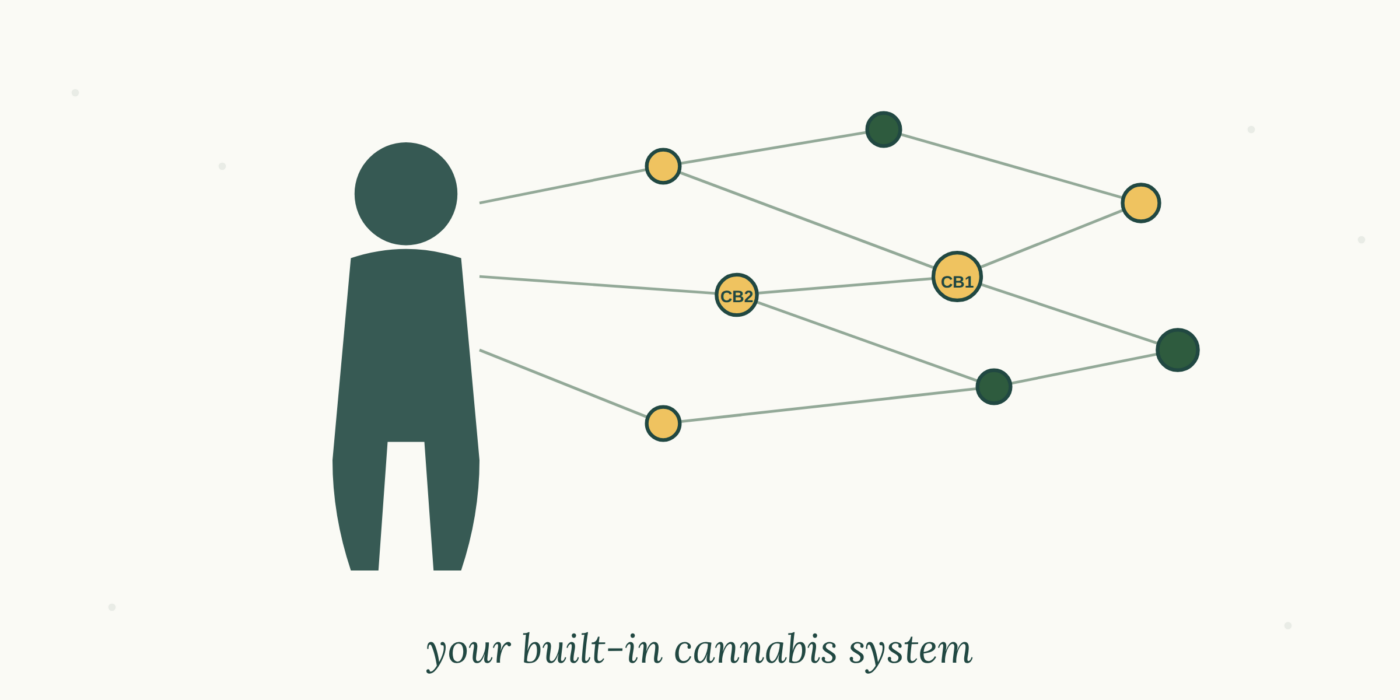
Your body has a built-in system that interacts with cannabis. It's called the endocannabinoid system, and it explains almost everything about how THC, CBD, and every other cannabinoid work.
For most of human history, we used cannabis without knowing why it worked. The plant's been cultivated for thousands of years for medicine, ritual, and recreation. But the actual mechanism — the biology behind the high — stayed hidden until about 35 years ago.
In the late 1980s and early 1990s, scientists trying to figure out how THC produced its effects discovered something completely unexpected: the human body has a built-in system of receptors that respond to cannabis. Not because we evolved to use the plant, but because our bodies naturally produce their own cannabis-like compounds. They called it the endocannabinoid system, and understanding it is the key to understanding almost everything else about cannabis.
What the Endocannabinoid System Actually Is
The endocannabinoid system (ECS) has three core parts:
The three components
- Receptors — specialized cell-surface proteins, mostly CB1 and CB2, spread throughout your body
- Endocannabinoids — cannabinoid compounds your own body produces, primarily anandamide and 2-AG
- Enzymes — proteins that create and break down endocannabinoids as needed
This system regulates an extraordinary range of biological functions: sleep, mood, appetite, pain perception, immune response, memory, reproduction, temperature regulation, and more. The research community sometimes calls it the "master regulator" because it helps maintain homeostasis — the body's internal balance — across nearly every major system.
CB1 and CB2: The Two Main Receptors
CB1 Receptors
CB1 receptors are heavily concentrated in the brain and central nervous system. They're found in the hippocampus (memory), cerebellum (coordination), basal ganglia (movement), and prefrontal cortex (decision-making). They're also present in smaller numbers throughout the body.
When THC binds to CB1 receptors, you feel what we call a "high" — altered perception, euphoria, relaxation, altered sense of time, increased appetite. At higher doses, the same binding can produce anxiety, paranoia, and impaired coordination. Every effect of THC, good or bad, starts at a CB1 receptor.
CB2 Receptors
CB2 receptors live mostly outside the brain — in the immune system, spleen, tonsils, peripheral nerves, and gut. They play a major role in inflammation and immune response. CB2 activation doesn't produce a high; it's more associated with anti-inflammatory and immune-regulating effects.
This is a big part of why CBD is studied for conditions involving inflammation — it interacts with the CB2 system (and several others) without binding strongly to CB1. You can get CBD's effects without getting high.
Why This Matters for Shoppers
When you see a product labeled "non-intoxicating" or "functional" CBD, what that really means is the compound preferentially engages CB2 and other pathways rather than CB1. When you see a potent THC product, it's because the compound is aggressively activating CB1. Understanding which receptor does what is how you match product to goal.
Endocannabinoids: Your Body's Own Cannabis-Like Compounds
Here's the part that surprises most people: your body produces its own cannabinoids, completely independent of whether you ever use cannabis. The two most-studied are:
- Anandamide (AEA) — named after the Sanskrit word ananda, meaning "bliss." It's associated with the runner's high and with mood regulation. Anandamide binds primarily to CB1.
- 2-arachidonoylglycerol (2-AG) — the most abundant endocannabinoid in the body. Plays a role in immune function, pain modulation, and appetite. Binds to both CB1 and CB2.
Your body makes these on demand — they aren't stored up. When something triggers the need (exercise, stress, injury, hunger), enzymes rapidly synthesize the relevant endocannabinoid, it binds to its receptor, does its job, and other enzymes break it down almost immediately. The whole process is local, fast, and self-limiting.
How Plant Cannabinoids Fit In
Phytocannabinoids — the cannabinoids from the cannabis plant — happen to have molecular shapes that let them bind to the same receptors your endocannabinoids use. That's a coincidence of plant chemistry, not design. Each plant cannabinoid interacts with the system differently:
| Cannabinoid | Primary Target | Effect |
|---|---|---|
| THC | CB1 (strong agonist) | Intoxicating, euphoric, appetite-stimulating |
| CBD | Multiple pathways, weak CB1/CB2 | Calming, anti-inflammatory, non-intoxicating |
| CBG | CB1 & CB2 (weak) | Alert, non-intoxicating, potential focus |
| CBN | CB2 (preferential) | Associated with sedation |
| THCV | CB1 (antagonist at low dose) | Clear-headed, appetite-suppressing |
For a deeper look at individual cannabinoids, see our guide to THC, CBD, CBN, CBG, and the entourage effect.
Why Cannabis Affects People Differently
Ever notice one friend gets completely couch-locked from an edible while another barely feels it? Same dose, same product, wildly different experience. The endocannabinoid system is a big part of why.
ECS function varies from person to person based on:
- Receptor density — how many CB1 and CB2 receptors you have
- Enzyme activity — how quickly you break down cannabinoids (genetic)
- Baseline endocannabinoid levels — influenced by diet, sleep, stress, exercise
- Recent cannabis use — frequent use causes receptor downregulation (tolerance)
The body's response to cannabis isn't a fixed number. It's a dynamic system that shifts based on lifestyle and use patterns — which is also why taking a tolerance break can reset how you respond to a familiar product.
The ECS and Your Health Beyond Cannabis
A lot of research now investigates the ECS independent of cannabis entirely. Exercise boosts endocannabinoid levels — that's part of the "runner's high." Chronic stress and poor sleep suppress the ECS. Fatty acids from diet (omega-3s specifically) provide the building blocks for endocannabinoid production.
Researchers have even proposed that certain chronic conditions — migraine, fibromyalgia, IBS — might involve a poorly functioning ECS. This theory, called "clinical endocannabinoid deficiency," was advanced by Dr. Ethan Russo and remains an active research area (Russo, 2004). It's not a settled medical diagnosis, but it's changed how many researchers think about the system.
The Takeaway
The endocannabinoid system is why cannabis works. It's also why it works differently for different people, and why the same product might feel great one week and off the next. The more you understand what's happening under the hood, the better you'll be at matching products to goals, reading labels, and having conversations with consultants that actually get you somewhere.
Bottom Line
Your body was already working with cannabinoids before cannabis entered the picture. Every product you buy from The Highline is essentially giving your ECS a new set of inputs — and knowing which receptors each compound engages is how you predict what you'll actually feel.
What to look for at The Highline
A snapshot of the kinds of products our team can walk you through. Tap any category for what's in stock right now.
Local? We deliver to Dobbs Ferry, Ardsley, Irvington, and Yonkers. Or come visit us at 45 Main Street, Hastings-on-Hudson. Browse our live menu for what's in stock today.
Common Questions
What is the endocannabinoid system?
The endocannabinoid system (ECS) is a biological system in your body made up of receptors, enzymes, and naturally-produced compounds called endocannabinoids. It plays a role in regulating sleep, mood, appetite, pain, immune function, and more. Cannabis compounds — phytocannabinoids like THC and CBD — interact with the same receptors your body's own endocannabinoids use.
What's the difference between CB1 and CB2 receptors?
CB1 receptors are concentrated in the brain and central nervous system — they're primarily responsible for the psychoactive effects of THC. CB2 receptors are found mostly in the immune system and peripheral tissues — they're associated with inflammation and immune response, and are a key reason CBD is studied for anti-inflammatory applications.
Does everyone have an endocannabinoid system?
Yes — every vertebrate animal has an endocannabinoid system, including all humans. The system was discovered in the 1990s by researchers investigating how THC produces its effects. What scientists learned is that your body makes its own cannabinoids regardless of whether you ever use cannabis.
Why does cannabis affect people differently?
Everyone's endocannabinoid system is slightly different — receptor density, enzyme activity, and baseline endocannabinoid levels vary from person to person. This is part of why the same product can leave one person relaxed and another anxious. Genetics, diet, sleep, and stress all influence ECS function.
What is endocannabinoid deficiency?
Endocannabinoid deficiency is a theory — proposed by researcher Dr. Ethan Russo — that some chronic conditions like migraine, fibromyalgia, and irritable bowel syndrome may involve an underactive endocannabinoid system. Research is ongoing. It's not a formal medical diagnosis, but it's an active area of study.
Keep Reading
Ready when you are.
Three ways to start — whichever fits your day.
Or join the VIP list for new drops and member-only deals →